Prehistoric India to 1000 B. C by Piggott Stuart
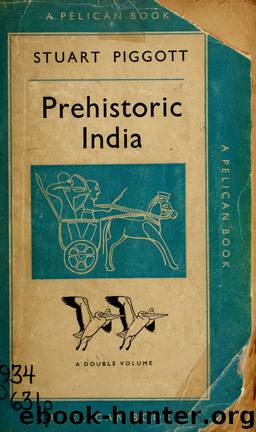
Author:Piggott, Stuart
Language: eng
Format: epub, mobi
Publisher: Harmondsworth, Middlesex: Penguin Books
city-state were vested in the chief deity, i.e. in the priesthood or a priest-king. The civic focus was the exalted temple, centre of an elaborate and carefully ordered secular administration under divine sanction ... In essence, the picture is one of a rigid and highly evolved bureaucratic machine, capable of organizing and distributing surplus wealth and defending it, but little conducive to the political liberty of the individual.5
A state ruled over by priest-kings, wielding autocratic and absolute power from two main seats of government, and with the main artery of communication between the capital cities provided by a great navigable river, seems, then, to be the reasonable deduction from the archaeological evidence of the civilization of Harappa. To maintain the populations of such cities, and of the smaller towns to a large extent as well, an agrarian system sufficiently well organized to produce the necessary surplus must have existed, but there is no direct evidence of its nature, or of the systems of artificial irrigation which might well be expected to accompany it. We know that bread wheat (Triticum compactum and sphaerococcum) and barley (Hordeum vulgare and the hexastichum variety) were grown, as well as sesamum and field peas (Pisum arvensis), and a species of Brassica (perhaps B. juncea, the modern Indian rai). The cereal crops are of sufficient interest to merit further discussion.
Barley is a grain which has been cultivated from very early times in Western Asia; it is attested to in Tell Halaf times at Arpachiyah in Northern Mesopotamia, and in the Egyptian Fayum at a time probably contemporary with the Uruk phase of ancient Mesopotamia. The Egyptian finds include, significantly enough, the hexastichum (six-row) variety of barley, as in prehistoric India, and the wild varieties of the grass from which the cultivated grain was produced still grow in Turkestan, Persia, and North Afghanistan. The
wild ancestors of what is known as bread wheat (with 21 chromosomes as against 14 and 7 in the other two main wheat groups) are unknown, but it is interesting to note that the most primitive forms of the cultivated varieties are grown today in Persia, Afghanistan, the region around Bokhara, Kashmir, and Western India, and there is some reason to think that the sphaerococcum and compactum forms may be the earliest forms of bread wheat, arising out of hybridization of the other wheats with kindred grasses. On botanical grounds such workers as Vavilov have suggested that bread wheat originated on the Himalayan edge of Afghanistan; others have looked to the region between the Zagros Mountains and the Caspian. The archaeological evidence is slight, but impressions of bread wheat grains of the Triticum vulgare group were found in potsherds from Anau I in Turkestan, and point to the early emergence of the type in regions not too remote from Western India, where the Harappa Culture evidence shows that bread wheats were being grown in the third millennium B.C.
We shall see that the storage of grain was, at Harappa at least, and by inference at
Download
Prehistoric India to 1000 B. C by Piggott Stuart.mobi
This site does not store any files on its server. We only index and link to content provided by other sites. Please contact the content providers to delete copyright contents if any and email us, we'll remove relevant links or contents immediately.
| Africa | Americas |
| Arctic & Antarctica | Asia |
| Australia & Oceania | Europe |
| Middle East | Russia |
| United States | World |
| Ancient Civilizations | Military |
| Historical Study & Educational Resources |
The Sympathizer by Viet Thanh Nguyen(4443)
The Rape of Nanking by Iris Chang(4255)
World without end by Ken Follett(3510)
Ants Among Elephants by Sujatha Gidla(3494)
Blood and Sand by Alex Von Tunzelmann(3240)
Japanese Design by Patricia J. Graham(3213)
The Queen of Nothing by Holly Black(2656)
City of Djinns: a year in Delhi by William Dalrymple(2580)
India's Ancient Past by R.S. Sharma(2492)
Foreign Devils on the Silk Road: The Search for the Lost Treasures of Central Asia by Peter Hopkirk(2482)
Tokyo by Rob Goss(2463)
Inglorious Empire by Shashi Tharoor(2462)
In Order to Live: A North Korean Girl's Journey to Freedom by Yeonmi Park(2408)
Tokyo Geek's Guide: Manga, Anime, Gaming, Cosplay, Toys, Idols & More - The Ultimate Guide to Japan's Otaku Culture by Simone Gianni(2400)
India's biggest cover-up by Dhar Anuj(2381)
The Great Game: On Secret Service in High Asia by Peter Hopkirk(2371)
Goodbye Madame Butterfly(2278)
Batik by Rudolf Smend(2210)
Living Silence in Burma by Christina Fink(2093)
